
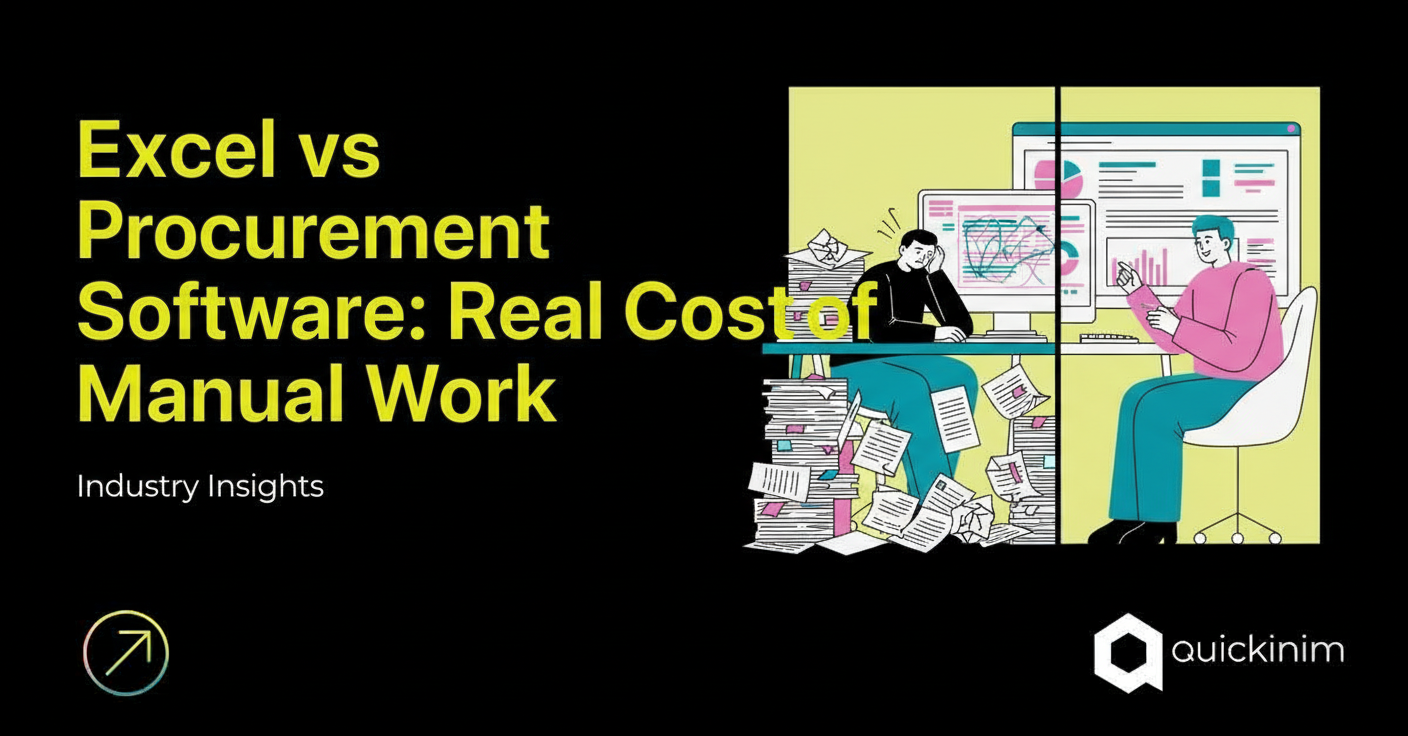
Excel vs. Procurement Software: The Real Cost of Manual Work
Excel vs. Procurement Software: The Real Cost of Manual Work
For decades, the humble spreadsheet has been the backbone of American procurement. It is flexible, familiar, and - perhaps most seductively - it feels "free." You already have the license, so why pay for dedicated software ?
But in the high-stakes world of supply chain management, "free" is a dangerous illusion. When you rely on Excel to manage thousands of dollars in spend, you aren't saving money. You are simply deferring the cost - and paying it back with interest in the form of labor hours, errors, and missed opportunities.
Here is the breakdown of the real price tag your company pays for sticking to the manuaol status quo.
1. The $15 Invoice and the Efficiency Gap
Let's look at the hard numbers. Research consistently shows that the administrative cost of processing a single purchase order or invoice manually hovers between $15 and $40.
Where does that money go ? It bleeds out in small increments: the AP clerk verifying data, the procurement manager chasing approvals via email, and the time spent keying data from a PDF into a spreadsheet cell.
By contrast, automated procurement platforms drive that cost down to as low as $3 per transaction. For a mid-sized manufacturer processing just 1,000 orders a month, the difference is staggering:
-
Manual Workflow: ~$15.000/month
-
Automated Workflow: ~$3,000/month
-
Annual "Manual Tax": $144,000 lost to inefficiency.
2. The "Fat Finger" Tax: Why 88% of Spreadsheets Lie
We are human. We make typos. But in Excel, a typo isn't just a spelling error; it's a financial risk. Studies have found that nearly 88% of all business spreadsheets contain errors.
A misplaced decimal point, a broken formula link, or a copy-paste mistake can lead to overpayments that go unnoticed for years. One study found that rectifying a single procurement error costs an average of $53 in administrative time.
Consider the infamous "London Whale" incident, where a simple copy-paste error in a spreadsheet contributed to billions in losses for JPMorgan. While your stakes might not be in the billions, the principle remains: Excel provides zero safeguards against human error. There are no audit trails to tell you who changed that price cell or when the formula broke.
3. The Visibility Black Hole
The biggest cost of Excel isn't what you see - it's what you don't see. In a spreadsheet, data is static. It dies the moment you hit "Save." You cannot see:
-
Real-time shipment statuses.
-
Live inventory consumption.
-
Vendor performance trends over time.
You are effectively flying blind, making strategic decisions based on data that is days or weeks old. This "visibility gap" means you miss early payment discounts, fail to consolidate spend for better pricing, and get blindsided by supply chain disruptions.
4. The "Version Control" Nightmare
Sound familiar ? When your supply chain lives in a file, collaboration becomes chaos. You have multiple versions floating around email threads, creating a fragmented reality where no one knows which numbers are the "truth."
How Quickinim Closes the Gap
We built Quickinim not just to replace spreadsheets, but to eliminate the friction they create. We understand that moving away from Excel feels daunting, which is why we designed our platform to bridge the gap seamlessly.
-
From Static to Real-Time: Instead of manually updating status columns, Quickinim offers real-time order tracking. You and your team can see exactly where every shipment is, instantly.
-
Centralized Communication: Stop digging through Outlook. Quickinim centralizes all supplier chats directly on the order card, ensuring that requirements and changes are never lost in an inbox.
-
Zero-Friction Migration: We know you have data in Excel today. Our Smart Import tools allow you to upload your existing supplier lists and product catalogs in minutes, mapping your columns to our system automatically.
-
Warehouse Efficiency: Beyond purchasing, Quickinim generates automated packing lists with QR codes, allowing your warehouse team to receive goods in minutes rather than hours.
Stop Paying the "Manual Tax"
You wouldn't run a modern production line with 1990s machinery. Why handicap your procurement team with 1990s software ?
The transition to automation isn't just about saving time; it's about safeguarding your bottom line against errors and unlocking the capital trapped in inefficient processes.
Ready to calculate your potential savings ? Visit https://quickinim.com/ to learn more about our features and see how easy it is to switch from manual chaos to automated control.